Posts

Showing posts from December, 2022
Image
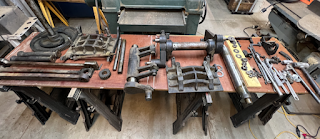
  SAVING MR GORDON Episode 7: December 31, 2022 A few spare moments put to use: masking small parts in preparation for painting. Having cleaned these parts earlier in the month, I found that I had a few spare minutes, which were sufficient time to mask and evaluate some small parts. I had to stop short on the pawl assembly, but I can finish it off next time I’m wearing expendable clothes (cleaning is such a dirty job).  Throwoff parts and the pawl cam, ready for paint.  The pawl assembly still needs a bit of cleaning, which I will address on the next relatively warm day when I’m wearing expendable clothes (cleaning is such a dirty job). I will further disassemble it before it's painted.
Image
Saving Mr. Gordon Episode 6: October 22, 2022 In which parts are cleaned mechanically, and a test reassembly is begun. Having been otherwise occupied in September, I had to let Mr. Gordon sit for a bit. Too bad, since I missed out on a lot of good weather. October 28 - After thoroughly cleaning the parts with a wire cup mounted to a grinder, I started to reassemble the frame for painting before the weather turned too cold. Note the D&P sitting in the background - it's a luxury to have a full-size pattern to follow for accurate reassembly.  November 4 - Now to carefully mask bearing surfaces before painting - I used dowels and rolled-up cardboard to mask the interiors of bearings and oiling points. November 9 - paint the frame November 12 -  Two coats of black later, it’s looking pretty sharp. Weather has turned cold, so progress will necessarily slow down for a while. To compensate, I’ve brought several smaller assemblies home with me to paint in my (somewhat)...
Image
Saving Mr. Gordon Episode 5: July 1, 2022 In which one press is disassembled and another is moved. After an interesting June (driving from Colorado to Wisconsin and back), it’s time to start cleaning the Gordon in preparation for painting and restoration. The idea is to take the press apart in a methodical manner and clean each piece in preparation for painting and reassembly. The good news is that I can lift each individual piece. The two largest pieces are the sides of the frame: Much cleaning, involving a grinder fitted with a wire cup. July 6: I drove into Denver to remove the treadle and hook from the Damon & Peets press. The treadle was originally cast, the hook is wrought iron. The idea was to measure it, make a  scale drawing of the hook, and prepare to crate it for shipping.  August 17: In Denver again, but with Don, Steve, and their tilt-bed trailer. The first order of business is to lift it off the temporary pallet and bolt it on a transport pall...
Image
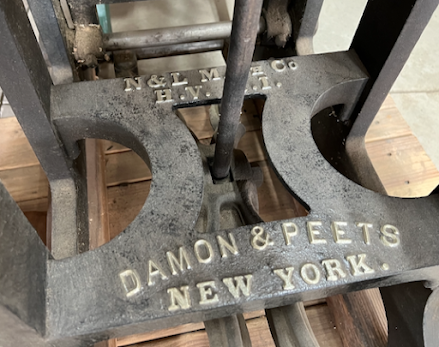
Saving Mr. Gordon  Episode 4: April 29, 2022      In which I investigate a similar press in Denver             (and we get deep into the mechanical weeds of split ink disk assemblies). I remembered having seen a similar press stored in Denver, which was being offered for sale by someone I knew of. Upon investigation, it was a Damon & Peets 9x13 New Style (Gordon) press, possibly manufactured at the same plant as the press I am restoring. Damon & Peets was a New York marketing operation, selling type and other printing supplies. They also offered their own line of presses, manufactured under license to GP Gordon at the Nichols & Langworthy Machine Company . This press (as shown below), was manufactured at that facility. The N&L Machine Co., located in Hope Valley, RI started by manufacturing weaving and mill machinery and expanded its repertoire to printing presses for George Gordon in 1853. They would continue maki...
Image
  Saving Mr. Gordon Episode 3: April 21, 2022 -  In which we test assemble the press to see if it works and what is missing (a bunch of stuff, as it turns out).  So Don and I assembled the press bit by bit, figuring it out as we went along. He knew from the start that the ink disk was missing (the previous owner claimed he didn’t know where it was). This is how it started, and is progressing:     Looking pretty good so far.  April 22, nearly everything is here. We’re missing a few machine screws (which is actually more problematic than it sounds), the two-part ink disk, and a gear that drives the interior disc (all of which will be explained in good time). Also no treadle - and the available reproduction treadles don’t fit. That may be a problem for ease of operation.      A variable-speed motor is always an option, but there is an organic feel to treading a press that is hard to describe. The operator is an integral part of the printing...
Image
Saving Mr. Gordon Episode 2: Who was GP Gordon? Having failed to make a living as an actor in the early 19th century, George Phineas Gordon apprenticed as a printer in New York. He must have taken to the work quite handily, for he soon opened his own printing house. An inveterate tinkerer, he began to concern himself with how printing presses were designed & used, and started designing presses.   His early innovations include the "Yankee Job Press" and the "Firefly," but his real breakthrough was the "Franklin" press, introduced in 1858. Gordon claimed that Benjamin Franklin had come to him in a dream and described the design and action of the press. It is only fitting that this style of press became the de facto standard model for job printing in the US.  The “Gordon Jobber” is what we refer to as an “Old Style” press, and thanks to the Chandler & Price Company, it is the most common platen press you will find in the US and possibly the world.  G...
Image
Saving Mr. Gordon Episode 1: April 19, 2022     W hat hath Don wrought? (or, another fine mess...) My good friend Don H. offered me a pallet of scrap press parts he had in storage. He had picked it up several years ago when he was moving a press for another friend (since deceased). It's been stored in the upstairs of his workshop and was starting to get in the way of other storage.  Naturally, since neither of us ever could say no to a pile of free cast iron, we set out to see what we could assemble from it.  Turns out, it was most of an original GP Gordon "New Style" platen press, circa 1870-1880.  After the initial test assembly, I figured this might eat up about a year’s worth of project time. Sure, there were parts missing - important parts too. Some I knew we could make, and some we might be able to figure out how to make if we couldn't track them down in the wild.   What follows is the story of how my friends and I try to save an antique printing pres...